The largest grass in the Mediterranean, growing to 6 metres. The stems are bamboo-like and the tough, glaucous leaves up to 6 cm wide. Strongly rhizomatous giving rise to dense patches. Flowering panicles emerge on two-year old stems and form a contracted mass of numerous small florets, furnished liberally with long, silky, purple-tinged hairs.
HABITAT:
Damp ground, still and slow-flowing water to a moderate depth, and dune slacks. Very catholic, tolerant of salinity and a range of soil types.
HISTORY:
Widely introduced in sub-tropical and tropical areas. An economically-useful species, the stems can be used for matting, weaving, roofing and the manufacture of woodwind instruments. Also planted to create shelter beds. More recent initiatives are investigating the use of Arundo for fuel, wood pulp and even as a food source. It is currently seen as a potential crop in parts of the region.
Arundo donax - Giant Reed Grass
Growing up to 15-18’, this grass is impressive. Big and vigorous, Arundo donax grows big and blooms huge feather like plumes in September. It likes moisture and is also tolerant of sea salt & wind. Great effect growing over a stream or pond where the large blue/green foliage will hang over the water. Native to Southern Europe, it is the primary wood for reed instruments, but can be invasive in warmer climates, but not in the Delaware Valley where it will form a large clump which may have to be thinned every 5-10 years. Excellent winter interest!
Arundo donax ‘Variegata’ - Giant Reed Grass (Pictured)
Growing very similar to species, this Giant Reed Grass has creamy yellow/white variegated foliage, but does not grow quite as large as the species. The same great impressive flowers and winter interest as species, just a different color.
Während der mehrjährigen Forschungs- und Entwicklungsarbeit ein dem Rohrholz Arundo Donax vergleichbares synthetisches Material zu finden, hatte Harry Hartmann eine Idee:
Bei einem Auftrittes mit seiner Gruppe, dachte er sich, daß es wohl das Beste sein müßte, das Naturmaterial soweit wie möglich nachzubauen. Dabei sollten alle positiven Eigenschaften des Rohrholzes beibehalten werden, während die negativen auszuschließen waren.
Im Laufe weiterer Untersuchungen stellte Harry Hartmann fest, daß die guten Klangeigenschaften von Arundo Donax durch zwei Hauptmerkmale entstehen. Zum einen sind das die längs verlaufenen Förderkanäle der Pflanze und zum anderen die diese umgebenden Zellen.
This is without discussion the most famous instrument from antiquity. It is founded already on the Cyclads around 2500 BC. It dissapeares a little time, but with the growing of Greek culture it comes back. The origin is connected to a myth. You can read that in the 'Metamorphosis' of Ovidius. Pan, a god born with the paws of a goat, horns and a hairy upper part of the body badgered on the Olympus. He left this world and established hisself in Arcadie. He is the god of the forest, the open country and is in general associated with nature. In the woods, he did only 3 things: play on his flute, pick up girls and stomp with his feet to scare the people. One day, he fell in love with the waternymph Syrinx. However, she did not want him and ran away from him. When she reached the river Ladon, which she couldn't cross, she begged Artemis that she would change here into something, because, falling in his hands was the last thing she wanted. When Pan held her, he noticed he was holding reed. He sighed and this caused a magical and comforting sound out of the holes. To find comfort, he plucked some stalks, bound them togheter and called it Syrinx. Beautiful isn't it ? :-) Still, in some stories, the pan-pipe is associated with Hermes (Cf. Homeric Hermes-hymne). But more and more, pan was associated with it. It became the instruments of the shepherds. Thats why it didn't get much appreciation by composers and intelectuals.
Picture: Private collections
Picture left : Musée Alésia, Alise-Saint-Reine
Picture right: Rijksdienst voor Oudheidkundig Bodemonderzoek
By blowing on the upper side, the air is vibrated in the tubes. The height of the tones depends on the lenght of the tube: the shorter the tube, the heigher the tune. In the early days, the tubes had an equal length and to tune the pan-pipes, one used wax. One put wax in the tube until the tune was just right. It was also used to close scratches or little openings in the side. The inside was also rubbed with wax to get a smooth sound. Later, one made the tubes out of different lenghts (CF; picture pan-pipe from Alesia). The notes of the pipes go from the lowest tone right, the highest one left. Strange, if we compare this with the piano, this is turned around.
users.pandora.be/avvakum/ ancient/pane.html
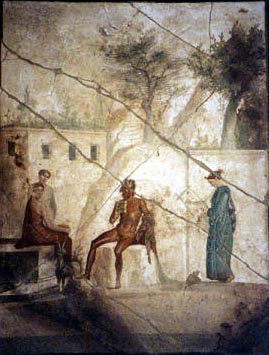
In this concert scene, Pan plays the syrinx. A nymph on the right plays the lyre. Pan's usual goat-like attributes are deemphasized in this painting, except for the small horns on his forehead. A small goat in the left foreground reinforces the Pan theme. The painting is in typical Augustan III Style.
www.art-and-archaeology.com/ roman/pom24.html
B C C# D Eb E F F# G Ab A Bb
13.032 12.312 11.750 11.062 10.375 9.906 9.250 8.750 8.250 7.750 7.720 6.844
6.643 6.000 5.688 5.375 5.040 4.725 4.442 4.178 3.864 3.628 3.415 3.210
2.958 2.772 2.547 2.476 2.233 2.122 1.956 1.785 1.593 1.492 1.448 1.356
Since you probably don't have a nice little saw jig like mine, i have developed a table of information on how long to cut your tubes by measuring off the lengths. You may find this table helpful for determining tube lengths regardless of tube diameter. The difference in pitch due to tube diameter is slight.