Keresés

Részletes keresés

spiroslyra Creative Commons License 2003.12.22 0 0 363
spiroslyra Creative Commons License 2003.12.22 0 0 362
spiroslyra Creative Commons License 2003.12.22 0 0 361
spiroslyra Creative Commons License 2003.12.22 0 0 360
spiroslyra Creative Commons License 2003.12.22 0 0 359
spiroslyra Creative Commons License 2003.12.22 0 0 358
Arundo donax A large annoyance/photo JMR
Arundo donax Another tedious plant/photo JMR
Arundo donax An aggravating plant/photo JMR
Arundo donax Plants dominating a landscape/photo JMR
Arundo donax Leaf sheaths/photo JMR
Arundo donax Variegated invader/photo BAR
Arundo donax About to get lost!/photo JMR
Arundo donax Along a river/photo JMR
Arundo donax Inflorescence/photo JMR
Arundo donax A flowering culm/photo JMR
Arundo donax Flowering plants/photo JMR

spiroslyra Creative Commons License 2003.12.22 0 0 357

NATIVE RANGE: India

DESCRIPTION: Giant reed, also known as wild cane, is a tall, perennial grass that can grow to over 20 feet in height. Its fleshy, creeping rootstocks form compact masses from which tough, fibrous roots emerge that penetrate deeply into the soil. Leaves are elongate, 1-2 inches wide and a foot long. The flowers are borne in 2-foot long, dense, plume-like panicles during August and September.

ECOLOGICAL THREAT: Giant reed chokes riversides and stream channels, crowds out native plants, interferes with flood control, increases fire potential, and reduces habitat for wildlife, including the Least Bell's vireo, a federally endangered bird. The long, fibrous, interconnecting root mats of giant reed form a framework for debris dams behind bridges, culverts, and other structures that lead to damage. It ignites easily and can create intense fires.

Giant reed can float miles downstream where root and stem fragments may take root and initiate new infestations. Due to its rapid growth rate and vegetative reproduction, it is able to quickly invade new areas and form pure stands at the expense of other species. Once established, giant reed has the ability to outcompete and completely suppress native vegetation.

DISTRIBUTION IN THE UNITED STATES: Giant reed is distributed from Arkansas and Texas to California, where it is found throughout the state, and in the east, from Virginia to Kentucky and Missouri and generally southward. Click here to see a distribution map.

HABITAT IN THE UNITED STATES: Giant reed becomes established in moist places such as ditches, streams, and riverbanks, growing best in well drained soils where abundant moisture is available. It tolerates a wide variety of conditions, including high salinity, and can flourish in many soil types from heavy clays to loose sands.

BACKGROUND: Giant reed was probably first introduced into the United States at Los Angeles, California in the early 1800's. Since then, it has become widely dispersed into all of the subtropical and warm temperate areas of the world, mostly through intentional human introductions. Today, giant reed is widely planted throughout the warmer areas of the United States as an ornamental and in the Southwest, where it is used along ditches for erosion control.

Giant reed has a variety of uses ranging from music to medicine. Primitive pipe organs were made from it and the reeds for woodwind instruments are still made from its culms, for which no satisfactory substitutes are known. It is also used in basketry, for fishing rods, livestock fodder, medicine, and soil erosion control.

METHODS OF REPRODUCTION & DISPERSAL: Reproduction of giant reed is primarily vegetative, through rhizomes which root and sprout readily. Little is known about the importance of sexual reproduction in giant reed, or about its seed viability, dormancy, and germination, and seedling establishment. Research on these topics may yield some additional improvements in the management of giant reed.

CURRENT MANAGEMENT APPROACHES: Areas infested with giant reed are best restored through chemical means. Mechanical control (e.g., repeated mowing) may be somewhat effective, but if small fragments of root are left in the soil, they may lead to reestablishment.

Systemic herbicides, such as glyphosate (e.g., Rodeo), may be applied clumps of giant reed, after flowering, either as a cut stump treatment or as a foliar spray. When applying herbicides in or around water or wetlands, be sure to use products labeled for that purpose to avoid harm to aquatic organisms.

Prescribed burning, either alone or combined with herbicide applications, may be effective if conducted after flowering. Once giant reed has been reduced sufficiently, native plants may be seeded or transplanted at the treated site.

USE PESTICIDES WISELY: ALWAYS READ THE ENTIRE PESTICIDE LABEL CAREFULLY, FOLLOW ALL MIXING AND APPLICATION INSTRUCTIONS AND WEAR ALL RECOMMENDED PERSONAL PROTECTIVE GEAR AND CLOTHING. CONTACT YOUR STATE DEPARTMENT OF AGRICULTURE FOR ANY ADDITIONAL PESTICIDE USE REQUIREMENTS, RESTRICTIONS OR RECOMMENDATIONS.

NOTICE: MENTION OF PESTICIDE PRODUCTS ON THIS WEB SITE DOES NOT CONSTITUTE ENDORSEMENT OF ANY MATERIAL.

For more information on the management of giant reed, please contact:

Team Arundo del Norte
http://www.ceres.ca.gov/tadn
Tom Dudley
tdudley@socrates.berkeley.edu
SUGGESTED ALTERNATIVE PLANTS: Native plant species that are adapted to local conditions should be used in restoration projects and as a substitute for giant reed in landscapes and erosion control practices.

--------------------------------------------------------------------------------

AUTHORS:

Nancy Benton, The Nature Conservancy, Arlington, VA.
Gary Bell, The Nature Conservancy, Santa Fe, NM.
Jil M. Swearingen, U.S. National Park Service, Washington, DC.

PHOTOGRAPHS:

John M. Randall, The Nature Conservancy, Davis, CA.

REFERENCES:

Hoshovsky, Marc. 1996. Element Stewardship Abstract: Arundo donax. The Nature Conservancy, Arlington, Virginia.

Perdue, R.E. 1958. Arundo donax - source of musical reeds and industrial cellulose. Economic Botany 12(4):368-404.

The Nature Conservancy. Giant Reed: Element Stewardship Abstract. In: Wildland Weeds Management & Research Program, Weeds on the Web.

Tidwell, B. 1995. Native Habitat Restoration: Controlling Arundo donax. Monsanto Company.

--------------------------------------------------------------------------------

Plant Conservation Alliance, Alien Plant Working Group (31 March 1998).

spiroslyra Creative Commons License 2003.12.22 0 0 356

Giant Reed


Poaceae


NATIVE RANGE:

Lower Himalayas


DESCRIPTION:

The largest grass in the Mediterranean, growing to 6 metres. The stems are bamboo-like and the tough, glaucous leaves up to 6 cm wide. Strongly rhizomatous giving rise to dense patches. Flowering panicles emerge on two-year old stems and form a contracted mass of numerous small florets, furnished liberally with long, silky, purple-tinged hairs.

HABITAT:

Damp ground, still and slow-flowing water to a moderate depth, and dune slacks. Very catholic, tolerant of salinity and a range of soil types.

HISTORY:

Widely introduced in sub-tropical and tropical areas. An economically-useful species, the stems can be used for matting, weaving, roofing and the manufacture of woodwind instruments. Also planted to create shelter beds. More recent initiatives are investigating the use of Arundo for fuel, wood pulp and even as a food source. It is currently seen as a potential crop in parts of the region.

spiroslyra Creative Commons License 2003.12.22 0 0 355

Arundo donax - Giant Reed Grass
Growing up to 15-18’, this grass is impressive. Big and vigorous, Arundo donax grows big and blooms huge feather like plumes in September. It likes moisture and is also tolerant of sea salt & wind. Great effect growing over a stream or pond where the large blue/green foliage will hang over the water. Native to Southern Europe, it is the primary wood for reed instruments, but can be invasive in warmer climates, but not in the Delaware Valley where it will form a large clump which may have to be thinned every 5-10 years. Excellent winter interest!

Arundo donax ‘Variegata’ - Giant Reed Grass (Pictured)
Growing very similar to species, this Giant Reed Grass has creamy yellow/white variegated foliage, but does not grow quite as large as the species. The same great impressive flowers and winter interest as species, just a different color.


Arundo dondax in winter.

spiroslyra Creative Commons License 2003.12.22 0 0 354
spiroslyra Creative Commons License 2003.12.22 0 0 353
spiroslyra Creative Commons License 2003.12.22 0 0 352

Während der mehrjährigen Forschungs- und Entwicklungsarbeit ein dem Rohrholz Arundo Donax vergleichbares synthetisches Material zu finden, hatte Harry Hartmann eine Idee:

Bei einem Auftrittes mit seiner Gruppe, dachte er sich, daß es wohl das Beste sein müßte, das Naturmaterial soweit wie möglich nachzubauen. Dabei sollten alle positiven Eigenschaften des Rohrholzes beibehalten werden, während die negativen auszuschließen waren.

Im Laufe weiterer Untersuchungen stellte Harry Hartmann fest, daß die guten Klangeigenschaften von Arundo Donax durch zwei Hauptmerkmale entstehen. Zum einen sind das die längs verlaufenen Förderkanäle der Pflanze und zum anderen die diese umgebenden Zellen.

So wurde das Vorbild Natur zum Prinzip Fiberreed.

spiroslyra Creative Commons License 2003.12.22 0 0 351
spiroslyra Creative Commons License 2003.12.22 0 0 350
spiroslyra Creative Commons License 2003.12.18 0 0 349
PAN-PIPE OR SYRINX

--------------------------------------------------------------------------------

This is without discussion the most famous instrument from antiquity. It is founded already on the Cyclads around 2500 BC. It dissapeares a little time, but with the growing of Greek culture it comes back. The origin is connected to a myth. You can read that in the 'Metamorphosis' of Ovidius. Pan, a god born with the paws of a goat, horns and a hairy upper part of the body badgered on the Olympus. He left this world and established hisself in Arcadie. He is the god of the forest, the open country and is in general associated with nature. In the woods, he did only 3 things: play on his flute, pick up girls and stomp with his feet to scare the people. One day, he fell in love with the waternymph Syrinx. However, she did not want him and ran away from him. When she reached the river Ladon, which she couldn't cross, she begged Artemis that she would change here into something, because, falling in his hands was the last thing she wanted. When Pan held her, he noticed he was holding reed. He sighed and this caused a magical and comforting sound out of the holes. To find comfort, he plucked some stalks, bound them togheter and called it Syrinx. Beautiful isn't it ? :-) Still, in some stories, the pan-pipe is associated with Hermes (Cf. Homeric Hermes-hymne). But more and more, pan was associated with it. It became the instruments of the shepherds. Thats why it didn't get much appreciation by composers and intelectuals.

Picture: Private collections


Picture left : Musée Alésia, Alise-Saint-Reine
Picture right: Rijksdienst voor Oudheidkundig Bodemonderzoek

By blowing on the upper side, the air is vibrated in the tubes. The height of the tones depends on the lenght of the tube: the shorter the tube, the heigher the tune. In the early days, the tubes had an equal length and to tune the pan-pipes, one used wax. One put wax in the tube until the tune was just right. It was also used to close scratches or little openings in the side. The inside was also rubbed with wax to get a smooth sound. Later, one made the tubes out of different lenghts (CF; picture pan-pipe from Alesia). The notes of the pipes go from the lowest tone right, the highest one left. Strange, if we compare this with the piano, this is turned around.
users.pandora.be/avvakum/ ancient/pane.html


spiroslyra Creative Commons License 2003.12.18 0 0 348

spiroslyra Creative Commons License 2003.12.18 0 0 347
spiroslyra Creative Commons License 2003.12.18 0 0 346

spiroslyra Creative Commons License 2003.12.18 0 0 345
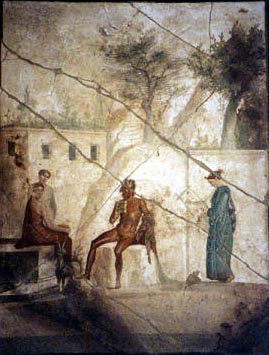
Pan and Nymphs
III Style, Pompeii

In this concert scene, Pan plays the syrinx. A nymph on the right plays the lyre. Pan's usual goat-like attributes are deemphasized in this painting, except for the small horns on his forehead. A small goat in the left foreground reinforces the Pan theme. The painting is in typical Augustan III Style.
www.art-and-archaeology.com/ roman/pom24.html

spiroslyra Creative Commons License 2003.12.18 0 0 344
< img src=http://www.art-and-archaeology.com/roman/pom24.jpg>

Pan Panamaba koltozott?:)

spiroslyra Creative Commons License 2003.12.18 0 0 343
spiroslyra Creative Commons License 2003.12.18 0 0 342
...behangoltunk:)

www.lightworker.com/~jp/ private/panflute.html

spiroslyra Creative Commons License 2003.12.18 0 0 341
spiroslyra Creative Commons License 2003.12.18 0 0 340


spiroslyra Creative Commons License 2003.12.18 0 0 339
spiroslyra Creative Commons License 2003.12.18 0 0 338
B C C# D Eb E F F# G Ab A Bb
13.032 12.312 11.750 11.062 10.375 9.906 9.250 8.750 8.250 7.750 7.720 6.844
6.643 6.000 5.688 5.375 5.040 4.725 4.442 4.178 3.864 3.628 3.415 3.210
2.958 2.772 2.547 2.476 2.233 2.122 1.956 1.785 1.593 1.492 1.448 1.356

Since you probably don't have a nice little saw jig like mine, i have developed a table of information on how long to cut your tubes by measuring off the lengths. You may find this table helpful for determining tube lengths regardless of tube diameter. The difference in pitch due to tube diameter is slight.

spiroslyra Creative Commons License 2003.12.18 0 0 337

spiroslyra Creative Commons License 2003.12.18 0 0 336
...hany daktilus?:)


spiroslyra Creative Commons License 2003.12.18 0 0 335
...hu az anyjat! Jol kinezunk...:)

spiroslyra Creative Commons License 2003.12.18 0 0 334
... egy kis fozocske...:)

Ha kedveled azért, ha nem azért nyomj egy lájkot a Fórumért!