http://www.ondamar.demon.co.uk/literat/classicl.htm
THE ORGAN IN CLASSICAL LITERATURE
The invention of the organ is traditionally credited to Ktesibios, an Alexandrian who lived in the third century BC. His instrument used water to generate and stabilise the flow of wind, and was therefore known as the 'hydraulic organ' or 'hydraulos'.
There are many uncertainties and ambiguities in our knowledge of the organ's early history. For example, the word 'organum' more often meant a tool, or a musical instrument of any kind, than a pipe-organ; and many of the early 'organs' were musical automata. One such was the Rhytum, praised in a poem by Hydelus of Alexandria (c.250 BC):
Come, all ye lovers of pure wine,
Come, and within Arsinoë's shrine
Behold the Rhytum: like th'Egyptian dancer
Besas, giving forth tones pure and bold,
Such is the Rhytum's mouth, outpouring.
It makes no sound of war;
But from its golden mouth
It signals mirth and revelry,
Such as the Nile, King of flowing rivers
Pours in watery sound from holy shrines,
Dear to the priests of sacred mysteries.
Then honour this invention of Ktesibios,
And hasten ye to fair Arsinoë's shrine.
The hydraulus earns a mention in Cicero's Tusculan Orations (c.50BC):
If a dear friend is overcome with grief, would you offer him a sturgeon rather than a treatise by Socrates? Would you urge him to listen to a hydraulus playing rather than to Plato discoursing?... Such are the remedies advocated by Epicurius; (his book) is a manual of Dissipation.
In Pliny's Natural History we read that:
... the dolphin, a creature fond not only of man but of the musical art, is charmed by harmonious melody, and especially the sound of the hydraulus.
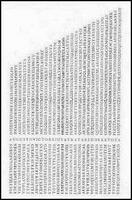
Porfyrius (aka Publilius) Optatianus (fl. c.320AD) wrote a 'concrete poem' containing passages in the shape of an altar, a syrinx and an organ (left). The organ pipes are represented by 26 vertical lines of verse, each of which increases in length by one letter, the last line being double the length of the first. The 'windchest', a single horizontal line, is placed beneath the 'pipes' and above the 'keyboard', which consists of 26 brief lines of equal length. The poem talks of the instrument:
...on which one can bring forth varied songs, and whose sounds escape from round open pipes of bronze whose length increases regularly. Below the pipes are placed the square-shaped keys by which the hand of the artist, opening or closing at will the conduits of wind, gives out a rhythmic, agreeable melody. Further below water lies hidden, agitated by swift breaths of air blown from this side and that by the concerted labour of hard-working youths, and fanned to greater volume by an answering blast. At the least movement, the levers, opening the pipes, express a symphony of sound in rapid and vigorous songs or a calm and simple melodies. The whole world will be dazzled by its metre and rhythms!
The Emperor Julian the Apostate (d.363) wrote a riddle-epigram in Greek about the organ:
I see reeds of a different kind, doubtless sprung from a soil of bronze. They are not moved by airy breezes, but by a breath rushing forth from a bag of leather which makes its way to the lower ends of the cunningly pierced reeds. A skilled man with nimble fingers stands there handling the keys which give voice to the pipes; and they, softly quivering in response, ooze forth a delicate sound.
Towards the end of the fourth century AD, the historian Ammianus Marcellinus lamented the decadence of the times:
As things stand today, the few houses that once were centres for the cultivation of serious study are overflowing with the wanton playthings of sluggish idleness, re-echoing with the sound of voices and the jangle of musical instruments... The libraries are sealed forever, like tombs, and men construct hydraulic organs and huge lyres looking like chariots...
Claudian (fl. c.400AD) wrote a poem which includes a passage about the Hydraulus:
"Let there also be one who, by his light touch, manages the many tongues of the field of bronze pipes, and with his nimble fingers causes a mighty sound; and who violently stirs, with a strong lever, the waters from whose tormet comes forth sweet music."
A poem by Isaac of Antioch (c.450AD) refers to the hydraulus:
A wave of meditation rushed in upon me, and threw me from place to place... even to the lovely city of the Greeks that looks out to sea, in the month of January last, when the music deprived the inhabitants of sleep. Every night I would hear the sounds of citharas, hydraulic organs and harps, playing before the palaces of the princes. At an hour when sleep is sweet, the music was clearly to be heard... Every night the instruments were set out, the hydraulus in every way resembling a man, and only rational speech distinguished man from the cithara... The flute was joined with the tongue, and the lips with the hydraulus, to make the desired sound as if from a single mouth. By its loudness the hydraulus dominated the other more delicate sounds, but it united with them so that the music reached the tops of the palaces; devoid of judgement and speech, the instrument joined forces with the men to make their voice heard far and wide. The sweet concord I then heard was wonderful. On a certain day I was asleep, and snoring, when the hydraulus sounded loudly, so that I awoke with a start and rose up with my brothers to perform our religious duties. And we came to the psalm which was to be recited at that hour... but the music of the delightful hydraulus seduced my mind, as though the strings of my soul's lyre had been released, so much did this music please me. In that moment the psalm returned to my mind and tightened my weak strings...
In the fifth century, Martianus Capella was the last Roman writer to mention the hydraulic organ. In his De Nuptiis Philologiae et Mercurii, he writes:
And lo! before the gate there arose a sweet melody of great charm, sung by the choir of the Muses... There was also the music of the tibias, and the sound of lyres, and the sonorous harmonies of hydraulic organs.
The same author recounted his travels in Egypt:
Everywhere I went I found citharists, kordax dancers, and players of the sambuca and the hydraulic organs for the benefit and use of mankind.
In about 500AD Theodoric the Great wrote of his minister Boethius' abilities in arranging 'spectacles':
He makes waters surge up from the depths and cascade down again; flames run evenly around; organs thunder forth strange sounds; and he fills the pipes with exotic blasts of air, which makes them utter a melodious sound...
In the early English version of the 'History of Apollonius, King of Tyre' (c.600AD) we find the following:
And the word spread throughout all the land that Apollonius, the famous king, had found his wife; and there was tremendous rejoicing and the organs were played and the trumpets blown, and a joyful feast was prepared by the king and the people.
As a farewell to the organ in the classical world, the composer Mesomedes of Crete (fl. c.130 AD) appears in Marguerite Youcenar's 'Hadrian' (1951), a fictional autobiography of the Roman Emperor. The Emperor and his entourage visit the Museum at Alexandria, and a concert is given on a collection of musical instruments. Old Dorian lyres, Phrygian pipes and African drums are heard; then:
My favourite musician, Mesomedes of Crete, used the water organ to accompany the recitation of his poem, The Sphinx, a disturbing, undulating work, as elusive as the sand before the wind.
As elusive as the memory of the hydraulus itself.
See also The organist in literature pt.1: from the classical world to 1880.


 Alexandra Pappas's personal free Blog
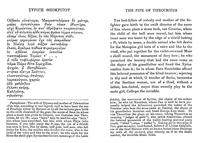 In the 1950's I stumbled upon The Greek Anthology - Vol 5 - Loeb Classical Library - 1953 - Book XV - MISCELANEA EPIGRAM 21- The Pipe Of Theocritus- A picture of the pipe of Pan in words written about Pan.
 The Sound of the Avian Syrinx
 Theocritean Syrinx
 agon
agon
 The Syrinx of Ps.-Theocritos 181